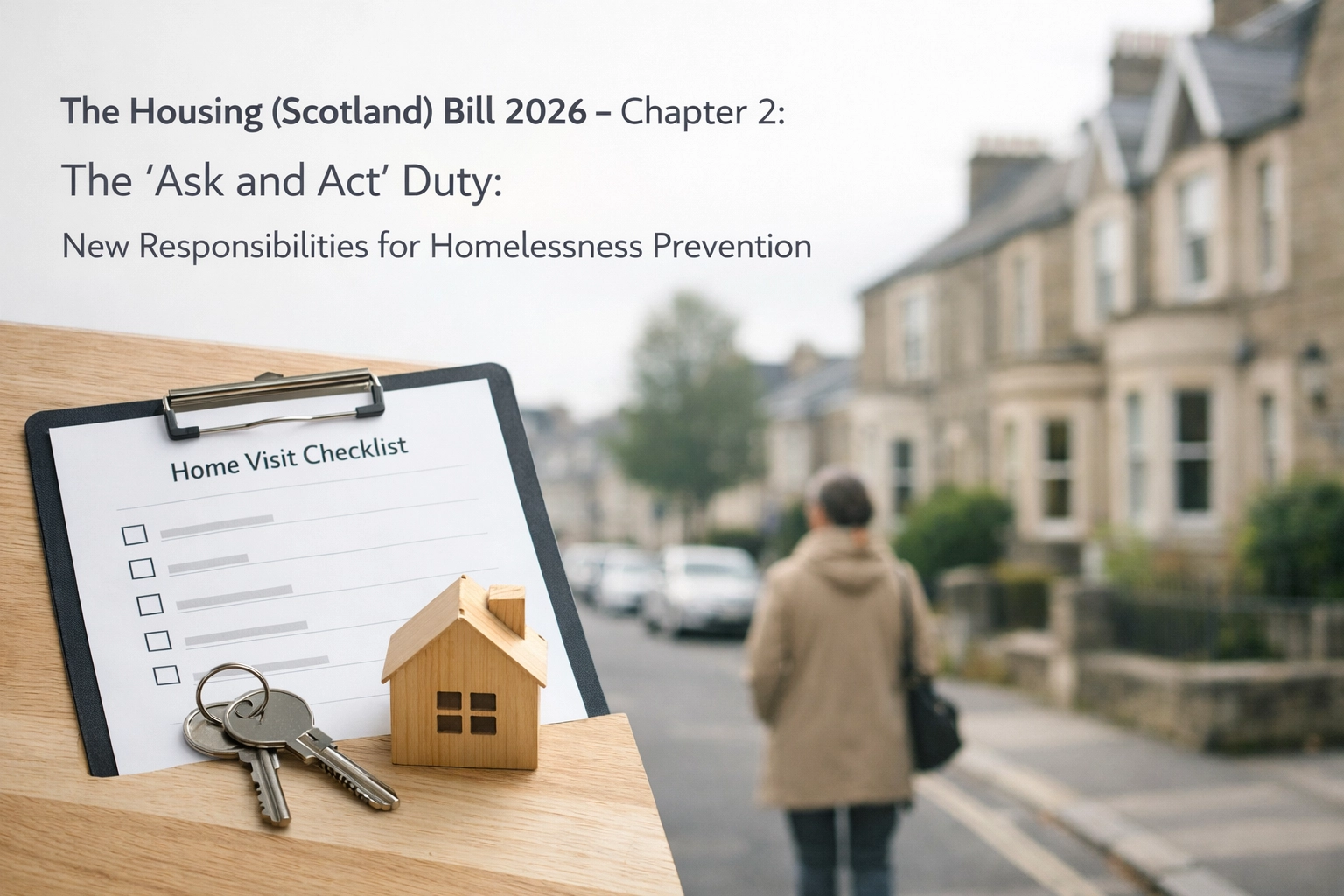
Scotland's approach to homelessness has always been distinct from the rest of the UK. The Housing (Scotland) Act 2025 takes this commitment a step further with the introduction of the 'Ask and Act' duty: a proactive, prevention-first framework that fundamentally changes how public bodies and housing providers identify and support people at risk of losing their homes.
For landlords, letting agents, and housing professionals, understanding this new duty is not optional. It represents a significant shift in responsibility, information-sharing, and intervention timelines that will reshape how tenancy issues are managed across Scotland.
The 'Ask and Act' duty is deceptively simple in concept but transformative in practice. It requires relevant public authorities to actively ask about the housing circumstances of individuals they interact with, and to act by either providing support directly or referring them to their local authority for assistance.

This moves Scotland's homelessness system from a reactive crisis model to a preventative intervention model. Rather than waiting for someone to present as homeless, the duty creates multiple touchpoints across public services where housing instability can be identified early and addressed before it escalates.
The underlying philosophy is straightforward: homelessness is easier to prevent than to resolve. By creating a network of "early warning systems" across different public services, the Act aims to catch people before they fall through the gaps.
The duty applies to a wide range of public bodies, including:
Each of these organizations interacts with vulnerable populations in different contexts. A GP might notice a patient's address has changed multiple times. A police officer might respond to a domestic incident where housing security is at risk. A teacher might become aware that a student's family is facing eviction.
Under the 'Ask and Act' framework, these professionals are not just encouraged to inquire about housing stability: they are legally required to do so when appropriate, and to ensure the person is connected with homelessness prevention support.
For social landlords (including councils and housing associations), the duty goes deeper. They are expected to have systems in place to identify tenants at risk and to work collaboratively with other agencies to prevent homelessness before a tenancy reaches breaking point.

One of the most significant changes introduced by the Act is the extension of the prevention timeline from two months to six months.
Previously, local authorities were required to provide homelessness support when someone was threatened with homelessness within 56 days. The new legislation pushes this threshold out to six months before homelessness appears imminent.
This might seem like a technical adjustment, but the practical implications are profound.
A tenant who receives a notice to leave, faces rent arrears, experiences relationship breakdown, or loses employment now has a much longer runway for intervention. It gives housing officers, support workers, and landlords more time to explore alternatives: whether that's negotiating payment plans, accessing financial assistance, securing alternative accommodation, or resolving tenancy disputes.
For landlords and letting agents, this means earlier involvement from local authorities. If a tenancy is showing signs of stress, you may find council homelessness teams reaching out proactively rather than waiting for the situation to deteriorate.
The Act introduces new information-sharing provisions designed to break down silos between different public bodies and housing providers.
Social landlords will now have greater access to information from organizations such as the NHS, local authorities, and social services when a tenant is identified as being at risk of homelessness.

This could include:
The aim is to create a coordinated safety net where different agencies can work together to stabilize a tenancy before it fails. However, this also raises important questions about data protection, consent, and how information is used ethically.
For landlords, this means you may be contacted by agencies you haven't traditionally worked with. A social worker or health visitor might reach out regarding a tenant's circumstances. While this may feel unfamiliar, it reflects the new collaborative framework the Act is establishing.
Courts in Scotland will gain new powers to delay when an eviction is carried out, even after a possession order has been granted.
This is not about preventing legitimate possession: it's about creating additional time for prevention interventions to work.
If a local authority can demonstrate that they are actively working with a tenant to secure alternative accommodation, access support services, or resolve the underlying issue, a sheriff may choose to delay the enforcement of the eviction order.
For landlords, this introduces an element of unpredictability into possession timelines. Even with a valid ground for eviction and a court order in hand, you may face delays if the tenant is deemed at risk of homelessness and prevention work is underway.
The balance here is delicate: landlords have legitimate reasons for seeking possession, but the Act prioritizes homelessness prevention wherever possible.
The Act includes specific protections for tenants experiencing domestic abuse, recognizing that this is a major driver of homelessness, particularly for women and children.
Social landlords are now required to develop written policies outlining how they will support tenants at risk of homelessness due to domestic abuse. This must include:

For many housing providers, this will require significant policy development and staff training. Frontline staff need to be equipped to recognize signs of abuse, respond appropriately, and connect tenants with specialized support without putting them at further risk.
This is not just a compliance exercise: it's about making housing a pathway out of abuse rather than a barrier to safety.
The 'Ask and Act' duty fundamentally changes the relationship between landlords, tenants, and public services.
You may be contacted earlier by local authorities when a tenancy shows signs of stress. Housing officers may reach out before formal arrears notices are issued or before you've initiated any possession process.
Information sharing will increase. While tenant privacy remains protected, you may find yourself part of multi-agency discussions about tenancy sustainment, particularly for vulnerable tenants.
Eviction timelines may be less predictable. Even with valid possession grounds, courts may delay enforcement if prevention work is ongoing.
Collaboration will be expected. Landlords who work constructively with local authorities and support agencies to prevent homelessness will find the system easier to navigate than those who take a purely transactional approach.
The duty does not remove your rights as a landlord. You can still pursue possession for legitimate reasons. But the system now expects housing providers to be active participants in homelessness prevention, not passive observers.
The 'Ask and Act' duty is not just legislation: it's a cultural shift in how Scotland addresses housing instability.
It moves responsibility for identifying and supporting at-risk tenants beyond housing departments and spreads it across the entire public sector. It creates a framework where a conversation with a nurse, a police officer, or a teacher could be the intervention that keeps someone housed.
For housing professionals, this represents both a challenge and an opportunity. The administrative burden may increase, and processes may take longer. But for landlords who value tenancy stability and long-term relationships, early intervention can prevent costly void periods, property damage, and legal proceedings.
Now is the time for landlords and letting agents to get familliar with the framework, review internal processes, and prepare for a more collaborative, prevention-focused approach to tenancy management.


Let Tech Solutions Ltd is an Appointed Representative of George Stubbs Insurance Services Ltd, which is authorised and regulated by the Financial Conduct Authority.